
There is something deliberately unique about Isabella Russo Siqueira’s paintings and that is precisely the point. Stretched across the walls of Her Clique’s Lisbon gallery, the large-scale works on fabric carry the memory of two climates: the sudden tropical downpours of Cancun and the persistent Atlantic wind of Portugal. Together, they tell a story not just of an artist, but of movement itself.
The exhibition is called Vem de Longe, portuguese for “comes from far away” and it marks a significant milestone for Her Clique: the launch of its first artist residency programme.
A Gallery Built on Conviction
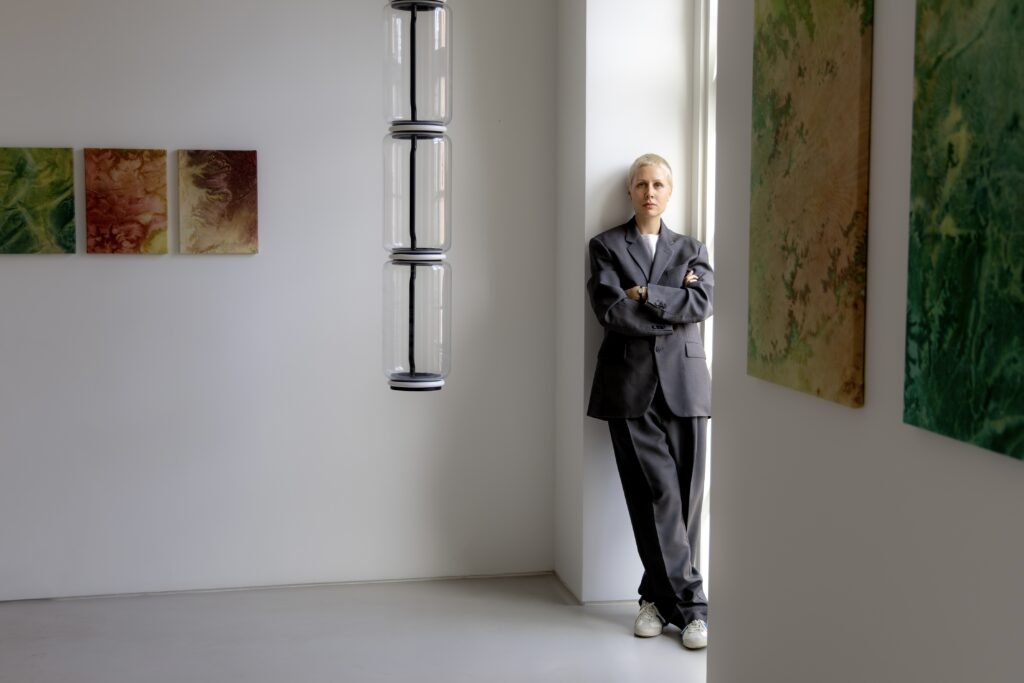
Her Clique was founded in 2020 by Izabela Depczyk, who had spent years navigating the art world from different angles, the publishing side, online auctions, and eventually the New York Academy of Art as part of the Board, where watching emerging artists develop their careers proved to be the most formative experience of all.
“That was probably the most impactful and empowering for me,” she recalls. “It really made me feel like I had all the tools and the experience to start something on my own.”
That something was a platform built with a clear mission: to champion women and queer artists in a market that, she felt, still underrepresented them. Within weeks of launching, COVID arrived. Rather than fold, she pivoted, moving Her Clique online and producing limited edition prints with over 50 artists, including Cindy Sherman and Marilyn Minter. More than half of the proceeds from those editions went to charities chosen by the artists themselves.
As the world reopened, so did Her Clique’s ambitions. Pop-up exhibitions gave way to a permanent space in the heart of Lisbon, steps from the castle, in a building that is both sober and generous, wide white walls that allow the work to breathe.
The choice of Lisbon was partly personal. “I’ve always had an affinity for Portugal,” she says. “You have to love the place you’re in.” But it was also strategic. Lisbon, she saw, was not an obvious hub for contemporary international art and that gap was exactly the opportunity.
Nature as Collaborator
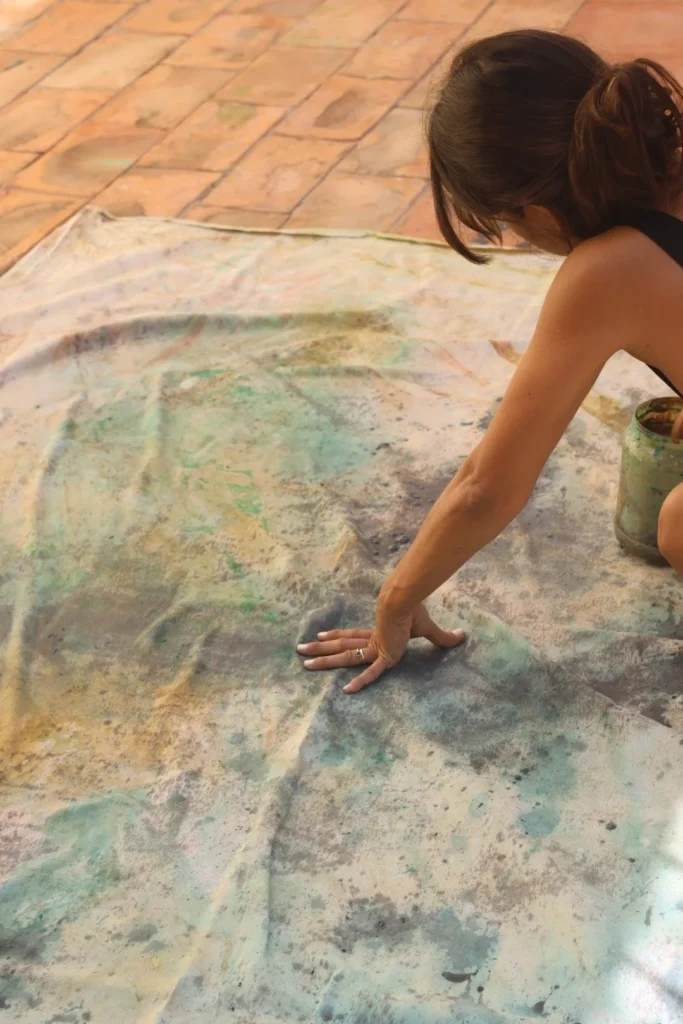
Isabella Russo Siqueira grew up in Cancun, Mexico, surrounded by the colours and textures of the natural world. She was always drawing, always making things, but for a long time, art felt more like a private pleasure than a viable path. It was only through university, where she studied design and fine arts, and through a growing circle of friends in the art world, that she began to take her practice seriously. Six years on, it is her life.
What defines her work is a deliberate surrender of control. She uses natural pigments on fabric and invites the elements: wind, rain, sunlight, temperature, to participate in the process. The results are impossible to replicate.
“I try to provoke accidents,” she explains.
In Cancun, the weather is bipolar: rain one moment, blinding sun the next. Each shift leaves a different mark. In Lisbon, the wind off the Atlantic moves the pigment in ways she had not encountered before. Cold temperatures slow the drying process, creating textures that warmer climates simply cannot produce. The fabric remembers everything.
This is intentional, not an accidental philosophy. Isabella wanted her materials to do more than represent nature; she wanted them to be nature, in some way. Natural pigments carry what she calls a “material memory,” spreading across the surface in patterns that synthetic materials would never allow. The result is work that feels organic and almost geological.
The Journey in the Work
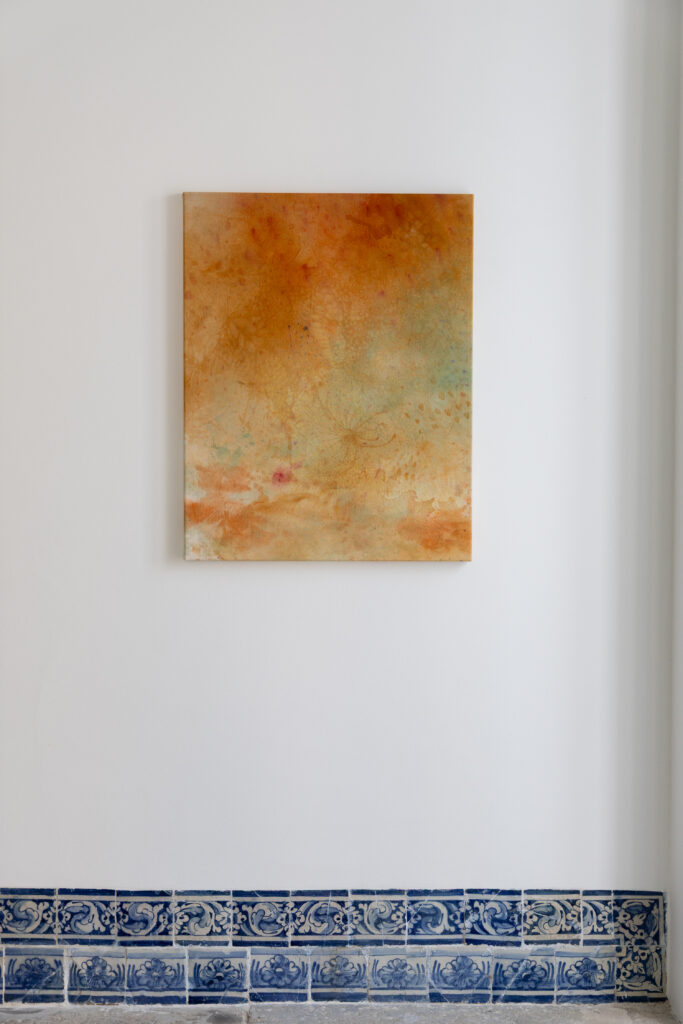
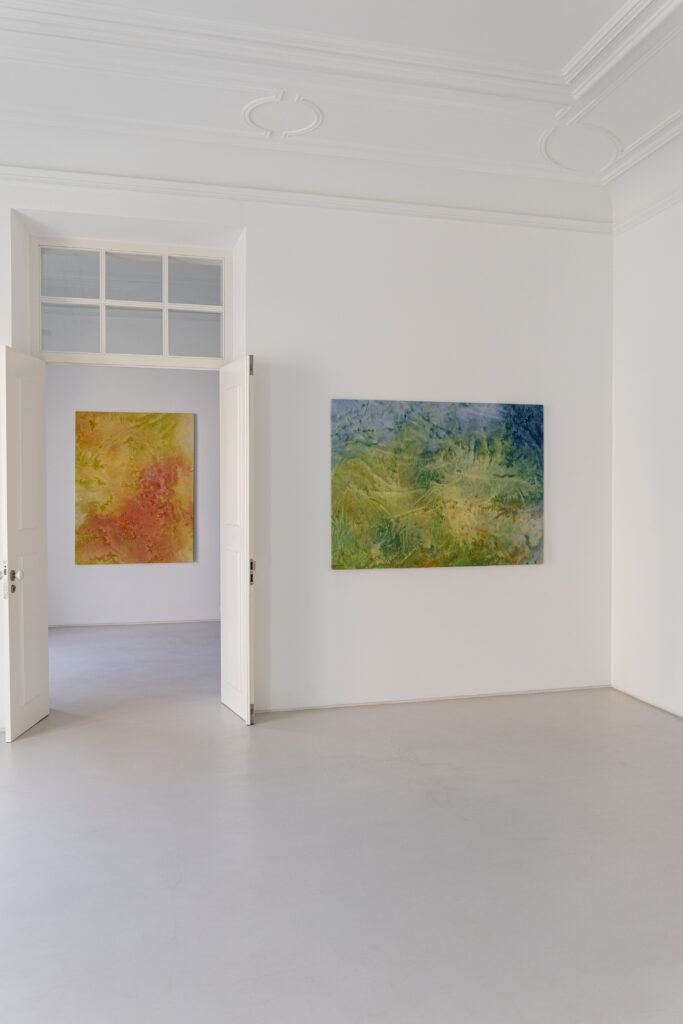
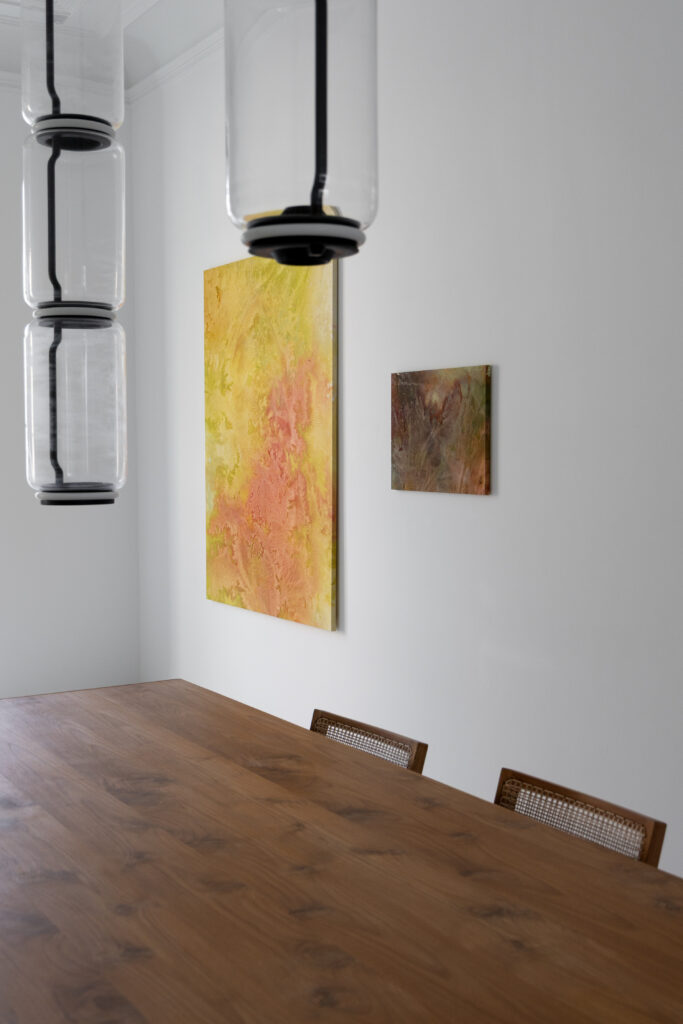
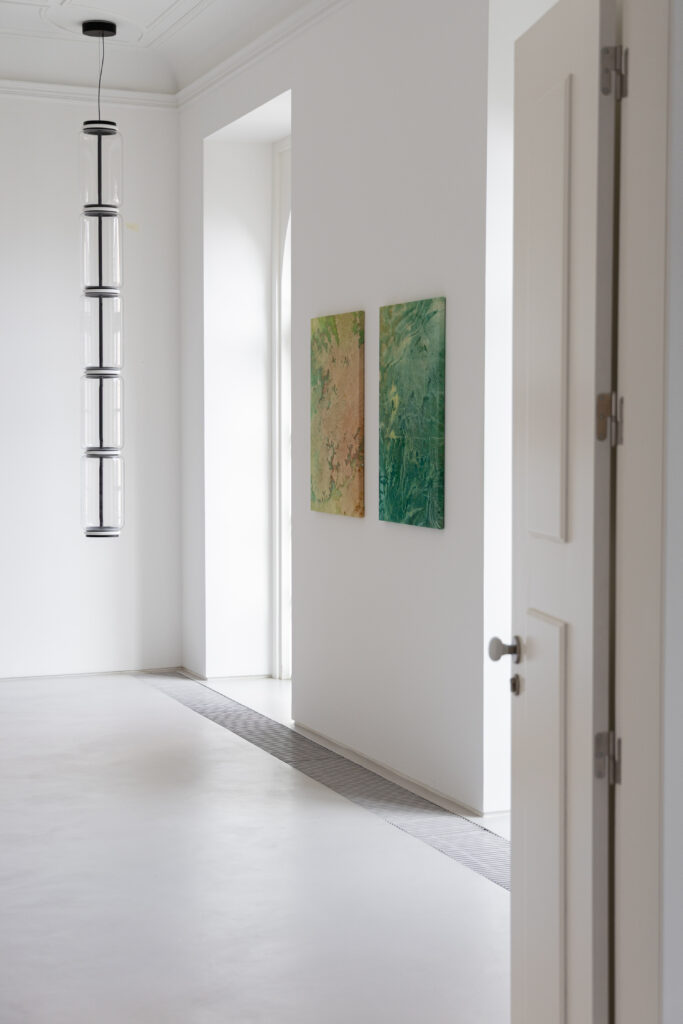
Vem de Longe is not a literal record of travel, but it is an honest one. The paintings were started in Cancun and continued in Lisbon. Each canvas carrying traces of both places, both climates, both moments in time. For Isabella, who comes from a lineage of migration (Italian ancestors who crossed the Atlantic generations before her), the concept resonates personally.
“I like to play with this idea,” she says. “We are humans on the earth, being a result of migration, different places, different things. Like this idea of cause and effect, something provokes these other things and we don’t control it.”
Depczyk, who is the gallery’s director and often curates the space once the works are complete, describes the installation as a journey in itself. “We think about what works well with the light,” she says, noting that a solo show, particularly one built around a single coherent concept, allows the gallery to focus on experience rather than context.
For visitors, Russo Siqueira hopes the paintings offer something closer to immersion than observation. She wants people to feel as though they are entering a garden, discovering different things as they move through the space. There is a phenomenon, called pareidolia, where the mind searches for familiar shapes in abstract forms: faces in clouds, landscapes in texture. It happens, she says, inevitably, in her work. A sunset here. Grass there. The ocean, if you look long enough.
“I allow for the audience to find their own representation,” she says. “If something touches you and you see a sunset in the painting, I would like for you to feel that.”
What Comes Next
After Lisbon, Russo Siqueira heads to France, deep in the countryside, where flowers are blooming and new materials are waiting to be discovered. She will continue producing and continue moving. Eventually, she hopes to return to Europe for another show.
There are also new directions forming. Sculpture, she says, is increasingly on her mind. The idea of a form that interacts physically with wind and sound feels like a natural next step.
For Her Clique, the residency programme is now a permanent part of its identity.
For Her Clique, the residency is the latest evolution of what the gallery does. The gallery’s mission, to platform artists who have historically been underrepresented, remains unchanged.
Vem de Longe is on view at Her Clique, Lisbon, until May 15.
Photos by Pernille Haugen, courtesy of Her Clique